What Is iGaming?

Lina Almans
Upd 6 days ago
Comment 0
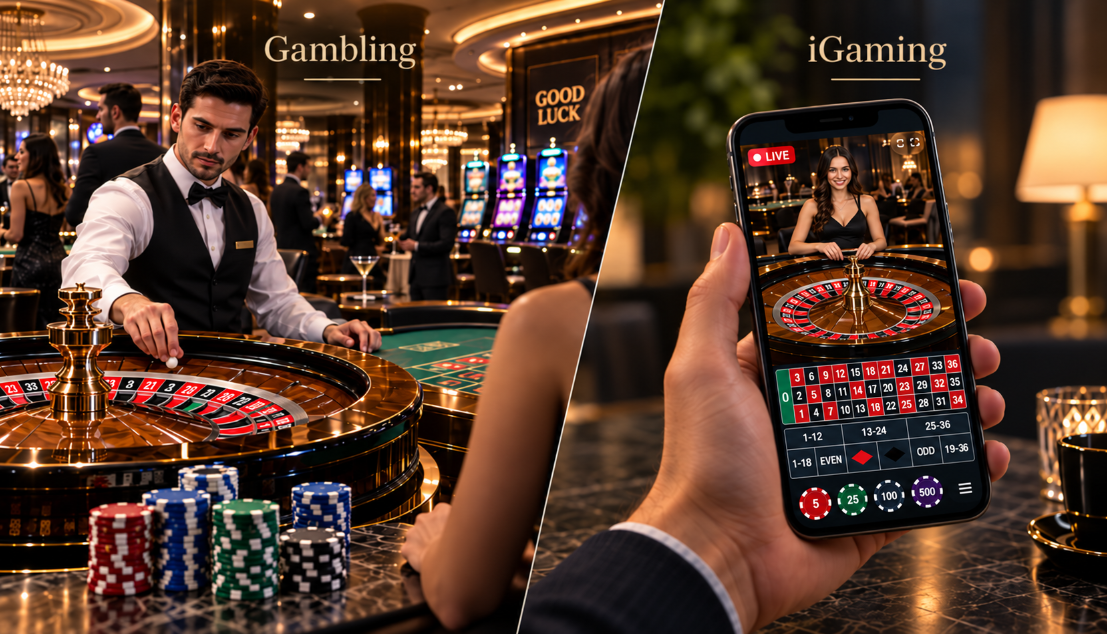
iGaming refers to the online gambling industry, covering products such as online casino games, sports betting, poker, bingo, and other forms of real-money gambling offered online. The term can also refer to the broader ecosystem around these products, including operators, software and content suppliers, payment companies, affiliates, and regulators.
What Does “iGaming” Mean?
The “i” in iGaming is generally understood to stand for “internet.” Within the gambling industry, iGaming is used as an umbrella term for online gambling and the businesses built around it.
“Interactive gaming” also appears in industry terminology, particularly in older usage, but today iGaming is most commonly associated with internet-based gambling.
The exact origin of the term is difficult to trace. Related terminology was already appearing in the gambling industry by the late 1990s. By 1998, the US had a trade publication dedicated to online gambling, Interactive Gaming News, while the B2B industry magazine iGaming Business was launched in 2003.
What Falls Under iGaming
iGaming typically covers several core products, along with a number of related or adjacent segments:
- Online casino — slots, roulette, blackjack, baccarat, and live casino games.
- Online betting — placing bets on sports, esports, entertainment, and other outcomes through betting sites and apps.
- Poker — online cash games and tournaments.
- Bingo — digital versions of the traditional game, including scheduled draws and player chat features.
- Lottery — a related segment that includes ticket purchases, draw entries, instant online lotteries, and digital scratch cards.
- Fantasy sports — an adjacent segment sometimes classified under iGaming and sometimes treated separately. Users build virtual teams made up of real athletes and earn points based on their performance.
- Social casino — games played with virtual chips that cannot be cashed out, with monetization typically coming from in-app purchases.
- Sweepstakes casino — a related model that uses social casino-style gameplay with a second virtual currency that can be redeemed for real prizes through sweepstakes promotions rather than direct wagering.
- Infrastructure and ecosystem — operators, software providers, platforms, payment providers, affiliates, and regulators that support the industry.
Crypto casinos and crypto betting are generally better understood as variations of existing iGaming products rather than separate gambling segments. They offer many of the same casino games and betting products as conventional platforms but allow users to deposit, wager, or withdraw using cryptocurrencies.
How iGaming Differs From Gambling, Betting, and Gaming
Although these terms overlap, they have different meanings:
| Term | What It Means |
|---|---|
| iGaming | Online gambling and the industry built around it |
| Gambling | Risking money or something of value on an uncertain outcome, both online and offline |
| Betting | Placing wagers on the outcome of sports or other events; it can take place online or offline |
| Gaming | Video games and esports without real-money stakes |
It is worth noting that in the names of gambling regulators, the word “gaming” often refers specifically to gambling — for example, the Malta Gaming Authority, Nevada Gaming Commission, and Pennsylvania Gaming Control Board.
The easiest way to understand the difference is through examples. A casino in Las Vegas is gambling, but not iGaming. Betting on a football match through a bookmaker’s app is betting, gambling, and iGaming at the same time. Playing a Counter-Strike match with no money being wagered is gaming, but not iGaming.
When Did iGaming Begin?
iGaming began taking shape in the mid-1990s. In 1994, Antigua and Barbuda passed the Free Trade and Processing Zone Act, which helped establish the legal framework later used to licence online gambling businesses. The first real-money online casinos and sportsbooks appeared soon afterwards. As internet access expanded, the market grew rapidly, and the rise of smartphones made online gambling even more accessible.
How the iGaming Industry Works
For players, it all looks simple: they open a website or app, deposit money, and place a bet. Behind the scenes, however, an entire chain of companies makes this possible.
- The operator works directly with the customer: registering players, accepting bets, managing accounts, and paying out winnings. This is the bookmaker, online casino, or other service whose brand the user actually sees.
- The provider creates the gaming content. In online casinos, this can include slots, roulette, and live casino games. In betting, providers may supply sports data, odds, or virtual events.
- Affiliates promote operators and bring in new players through websites, reviews, comparison pages, social media, and other marketing channels. They typically earn a commission for referred players through a fixed payment, revenue share, or a combination of both.
- The platform brings all of these elements together in one system: player accounts and balances, games from different studios, bonuses, limits, and reporting tools. This is such an important part of the business that, in some countries, companies developing this type of software need a separate licence. In Malta, for example, suppliers of critical gaming systems are licensed, while the UK has a separate licence for gambling software.
- Payment companies handle deposits and payouts. Alongside them are services responsible for customer identity verification, age checks, and anti-money laundering controls.
- The regulator sets the rules for the market and issues licences. Depending on the country, it may oversee operators, software, player protection, and compliance with legal requirements.
1xBet is a good example of how this infrastructure works in practice. The 1xbet.com website is operated by Caecus N.V.; it runs on the BetB2B technology platform; the brand offers gaming content supplied by a range of third-party providers; payments are processed by Exidna Enterprises LTD and Evrianassa Enterprises LTD; and the business operates under a Curaçao licence.
Is iGaming Legal?
There is no single gambling licence that allows an iGaming operator to operate worldwide. The legality of online gambling depends on the country — and sometimes even on the state, province, or other region within it. Some markets, such as the UK and Malta, as well as certain US states, regulate online gambling and require operators to obtain the relevant licence. In other countries, online casinos are prohibited altogether, or only certain forms of online gambling are permitted.
Curaçao is one of the best-known offshore licensing jurisdictions in the iGaming industry. Under its previous system, master licence holders could issue sub-licences to online gambling operators. The system changed on December 24, 2024, when new gambling legislation came into force and licensing moved under the Curaçao Gaming Authority. A Curaçao licence does not automatically give an operator the right to offer gambling services in other countries. Operators must comply with the laws and any applicable licensing requirements in the markets where they operate.
A note for US readers. Online gambling laws vary by state, with no single nationwide licence — sports betting is legal in most states, while online casino games are permitted in far fewer. Sweepstakes casinos use a sweepstakes-based model that allows them to operate outside traditional gambling licensing frameworks, but that legal space is shrinking fast: by 2026, a growing number of states — including California, New York, and New Jersey — had banned or effectively blocked the model.
Market Size and Statistics
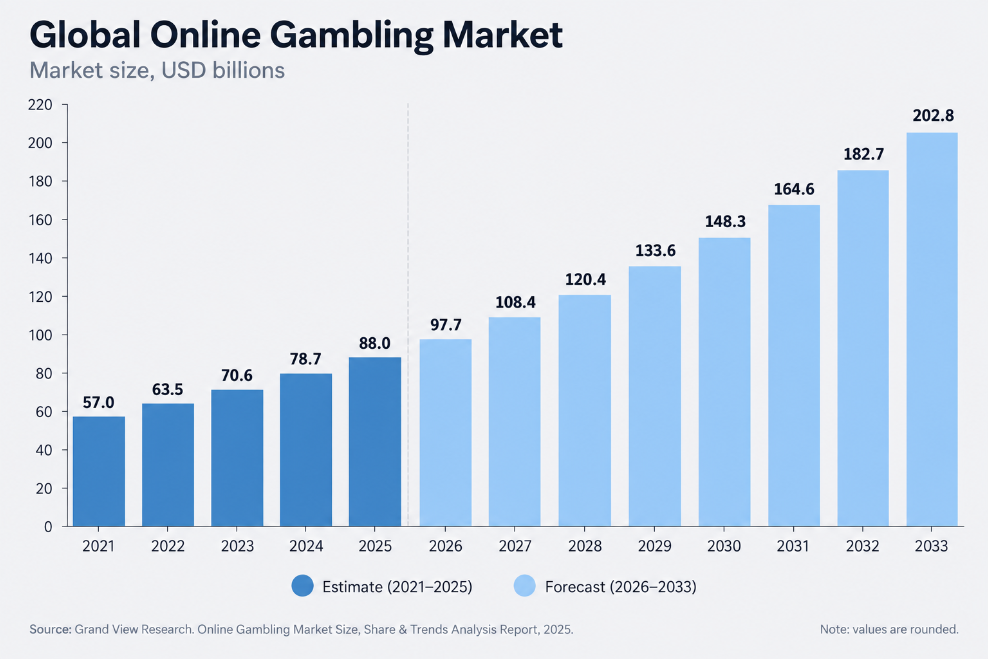
According to Grand View Research, the global online gambling market was valued at $88 billion in 2025 and is projected to reach $202.8 billion by 2033, representing a compound annual growth rate of about 11% from 2026 to 2033. Despite the rapid expansion of online gambling, land-based gambling still accounts for a significant share of the broader global gambling market.
Mordor Intelligence estimates that mobile and tablet platforms accounted for 57.14% of the global online gambling market in 2025, while IMARC Group puts mobile’s share at 68.7% in the US. Online wagering dominates US sports betting, accounting for 94.4% of total handle in the 12 months through February 2024, according to Eilers & Krejcik Gaming. Optimove also found that live, in-play bets made up 52% of total bet amounts among US sportsbook bettors in its 2024 dataset.
Sports betting remains the largest segment by revenue, accounting for around 50% of the global online gambling market in 2025, according to Grand View Research. Online casinos are another major part of the market, alongside poker, bingo, and other online gambling products.
INTERESTING:
In the United States, the National Council on Problem Gambling’s latest National Survey on Gambling Attitudes and Gambling Experiences (NGAGE 3.0), released in 2025, found that 8% of American adults — nearly 20 million people — reported experiencing at least one problem gambling indicator “many times” in the past year. Separately, the NCPG estimates that around 2.5 million U.S. adults experience a severe gambling problem in a given year.
INTERESTING: In Great Britain, the Gambling Commission’s Gambling Survey for Great Britain, published in 2025, found that 2.7% of adults — roughly 1.4 million people — scored 8 or higher on the Problem Gambling Severity Index (PGSI), the threshold used to identify problem gambling.
Conclusion
iGaming today is far more than online casinos and sports betting — it is an entire digital industry that brings together operators, content and software providers, payment services, technology platforms, affiliates, and regulators. The market continues to grow, while mobile gambling is becoming increasingly important. At the same time, the industry’s development still depends heavily on local laws, regulation, and licensing requirements.


Best Bonuses

Binance Referral ID — Inviter Code
Active Until: 22.12.2029
Along with up to $100 in welcome rewards, you receive a 5% fee rebate on Spot trading and a 5% fee rebate on Futures trading.

Win Win Promo Code – Valid Bonus Code Today
Active Until: 22.12.2028
Get 100% first-deposit bonus for sports betting, followed by extra bonuses on the 2nd, 3rd and 4th deposits after the welcome bonus has been wagered.

BitStarz Bonus Code – Welcome Bonus
Active Until: 22.12.2026
BitStarz offers a welcome bonus: up to $500 or 5 BTC, plus extra rewards after your first deposit.

Best Linebet Promo Code for New Users: 2 Welcome Bonuses
Active Until: 22.12.2026
Up to 1766 USD + 150 free spins for casino or a 100% sports bonus up to 117.89 USD on the first deposit.

Working 888starz.bet Promo Code – Sports & Casino Bonus
Active Until: 22.12.2027
Promo code unlocks the full welcome package, including up to €1500 + 150 Free Spins in the casino and up to €400 in sport.

Working Pinco Promo Code 2026 – Elite Welcome Rewards
Active Until: 22.12.2026
New players at Pinco can claim a 160% casino bonus on their first deposit by registering with the promo code GPARK.