Gambling in the United States

Lina Almans
Upd 4 days ago
Comment 0

Pictured: key figures in the U.S. gambling industry*
The scale of legal gambling in the United States exceeds $120 billion when the market’s two main segments are combined.
The first is the commercial sector: casinos, sportsbooks and online gambling platforms operating under state licenses. In 2025, this segment generated $78.7 billion in revenue.
The second is the tribal gaming sector: gambling operations run by Native American tribes under a separate regulatory framework based on the federal Indian Gaming Regulatory Act, or IGRA, and compacts with individual states. According to the latest available data, the sector’s annual revenue stands at $43.9 billion.
Fact: The United States is the clear global leader in gambling. Its gaming industry is larger by revenue than the markets of the United Kingdom, Australia and Singapore combined.
2025 was a record year for commercial gambling in the United States. The market grew by 9.1%, 34 of the 38 legal gaming jurisdictions reported growth, and many of them set new all-time records. Tax revenue reached $17.9 billion, up about 13% from 2024. These funds support schools, roads, pension programs and other state-level needs.
At the same time, a new force is growing: prediction market platforms such as Kalshi and Polymarket operate across many states, including some where traditional sports betting is prohibited. During the NFL season alone, prediction markets handled an estimated $3 billion to $5 billion in volume, while potential losses for state budgets are estimated at more than $1 billion.
Modern gambling in the United States has become a hybrid ecosystem where sports, finance and technology increasingly overlap. The old regulatory model is struggling to keep up. The market is changing — and now it needs new rules.
- *Jason Robins — co-founder of DraftKings, a company that started in fantasy sports and became one of the leading online sportsbook operators in the United States after sports betting was legalized.
- Tom Reeg — CEO of Caesars Entertainment. Under his leadership, the traditional Las Vegas casino brand expanded online: Caesars acquired William Hill, launched Caesars Sportsbook and became a major player in the U.S. betting market.
- Mike Dreitzer — head of Nevada’s gaming regulator. He went from working as a gaming regulation lawyer to overseeing the casino industry in Las Vegas.
- Christian Genetski — CEO of FanDuel. He rose from FanDuel’s legal team to become the head of a company that sets the pace in the legal sports betting market.
- Bill Hornbuckle — CEO of MGM Resorts, representing the old guard of Las Vegas. Under his leadership, BetMGM became one of the largest online gambling brands in the United States.
- Bill Miller — president and CEO of the American Gaming Association, the main lobbying group for the U.S. casino industry. His role is to speak for the industry in Washington.
- David Z. Bean — head of the association representing tribal casinos in the United States. He represents a sector where casinos are not just businesses, but also a source of revenue for Native American nations.
- Michael Selig — a representative of the CFTC, the U.S. federal financial regulator. For the gambling industry, he is important as one of the key figures involved in shaping the regulation of prediction market platforms.
Land-Based Casinos in the United States
Land-based casinos in the United States fall into two main categories: commercial casinos and tribal casinos. Commercial casinos operate under state licenses, while tribal casinos follow a separate model tied to the sovereign rights of Native American tribes.
FACT: There are 575 federally recognized tribes in the United States. Fewer than half are involved in the gaming business: in fiscal year 2024, 243 tribes operated 532 casinos and other gaming facilities across 29 states.
| Criteria | Commercial Casinos | Tribal Casinos |
|---|---|---|
| Owner | Private and public companies, including MGM Resorts, Caesars Entertainment, Wynn Resorts, PENN Entertainment and others | Native American tribes |
| Main regulator | State gaming commissions | The National Indian Gaming Commission, tribal gaming commissions and, on certain issues, state authorities |
| Legal framework | State laws | The federal Indian Gaming Regulatory Act, or IGRA, tribal regulation and compacts with states |
| Where they operate | On commercial land, where a state has legalized casinos and issued licenses | On tribal lands |
| Where the money goes | State and local government budgets | Tribal government budgets; some funds may go to states under tribal-state compacts |
| Taxes and payments | Revenue goes to operators; taxes and fees go to state and local budgets. | Revenue supports tribal government budgets and services; some payments may go to states under tribal-state compacts. |
| Scale | 493 commercial casinos in 27 states | More than 500 casinos in 29 states |
| Examples | Bellagio, Caesars Palace, MGM Grand, Wynn, Borgata, Encore Boston Harbor | WinStar World Casino, Foxwoods, Mohegan Sun, Seminole Hard Rock, Yaamava’ |
By revenue, traditional commercial casinos remain larger, but the gap with the tribal gaming sector is not huge: commercial land-based casinos generated $50.9 billion in 2025, compared with $43.9 billion for the tribal gaming sector in fiscal year 2024.


Online Casinos in the United States
While traditional commercial casinos in the United States generated $50.9 billion, their online counterparts brought in $10.7 billion. The gap is not due to a lack of demand, but to limited legalization: full-scale iGaming is available in only seven states — New Jersey, Pennsylvania, Michigan, Connecticut, Delaware, West Virginia and Rhode Island.
As in the land-based sector, the online market is divided into two models. In most states, commercial operators dominate, including DraftKings, FanDuel, BetMGM, Caesars, BetRivers and Golden Nugget.
There are exceptions. In Connecticut, tribes behind Foxwoods and Mohegan Sun play a key role. Michigan has a mixed system, with both Detroit’s commercial casinos and tribal operators represented in the market. In 2026, Maine allowed the Wabanaki Nations to launch online gambling, although the market has not yet gone live.
Limited legalization also leaves room for offshore sites. According to the AGA, offshore operators accepted around $402 billion in illegal wagers and diverted more than $17 billion in revenue away from the licensed market.

Sports Betting
Until 2018, most U.S. states could not legally launch sports betting markets. The main obstacle was PASPA, a federal law that prevented states from authorizing sports betting on their own. Nevada was the main exception, where sports betting, including mobile betting, was already available.
On May 14, 2018, the U.S. Supreme Court struck down PASPA. After that, each state gained the right to decide whether to allow sports betting, whether to launch online betting and what tax rates to set for sportsbook operators.
That decision triggered the American sports betting boom. State after state opened its market, while operators launched apps, signed partnerships with sports leagues and turned betting into a mass-market product.
☘️ The market’s two main players are FanDuel and DraftKings. Both started in daily fantasy sports, and when the federal sports betting ban was lifted in 2018, they already had millions of sports users. This helped them capture around 70% of the online market.
☘️ They are followed by BetMGM and Caesars Sportsbook, although both remain well behind the two leaders.
☘️ Fanatics is a different case. It did not start as a sportsbook, but as a major sports merchandise retailer that added betting to its app for 95 million customers.
☘️ bet365 is the world’s largest sportsbook, but in the United States it has expanded more slowly. Without its own local fan base or casino network, it has had to spend heavily on marketing, while its market share remains modest — below 5%.
☘️ Regional operators such as Hard Rock Bet and BetRivers continue to hold their niches. However, in terms of marketing scale, they are well behind FanDuel and DraftKings, which spend hundreds of millions of dollars on promotion.
☘️ ESPN BET only reinforced the same point: even a media giant struggled to break into a market dominated by FanDuel and DraftKings. The project was later discontinued after PENN Entertainment ended its partnership with ESPN.
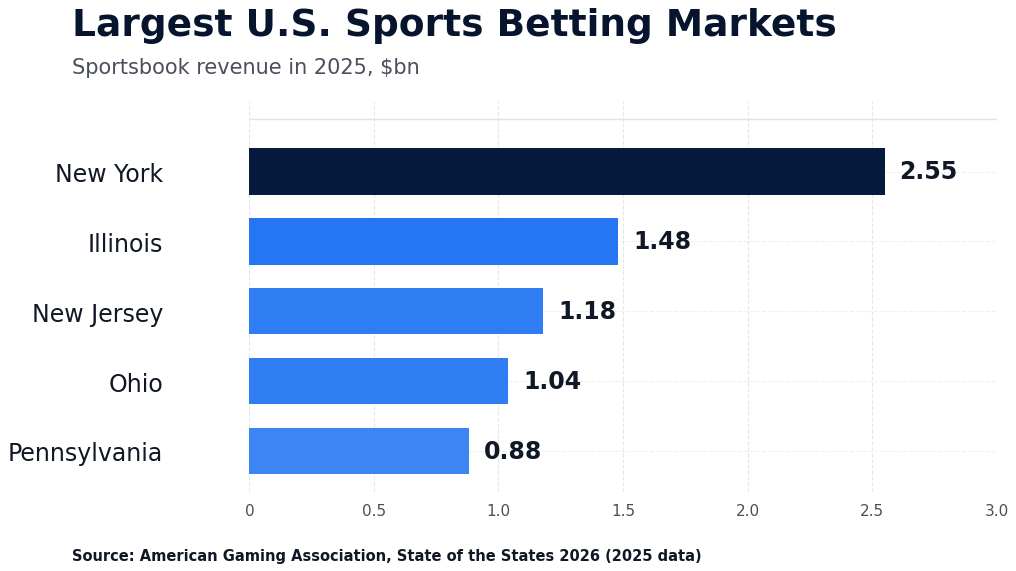
The largest markets by sports betting revenue, or GGR, are New York, Illinois, New Jersey, Ohio and Pennsylvania. New York remains the standout case: despite a 51% tax rate on online sports betting, it still leads the market by revenue. By comparison, the tax rate is 6.75% in Iowa and Nevada, while most states tax sportsbooks at 10% to 20%.
California and Texas are the industry’s holy grails. Legalization in either state could add $8 billion to $12 billion in betting handle. For now, however, the initiatives remain stuck in ballot-measure procedures and disputes with tribal operators.
Lotteries
Lottery ticket sales in the United States, both online and offline, reached $109.4 billion in 2025, according to Statista. This makes lotteries the largest segment of legal gambling in the country.
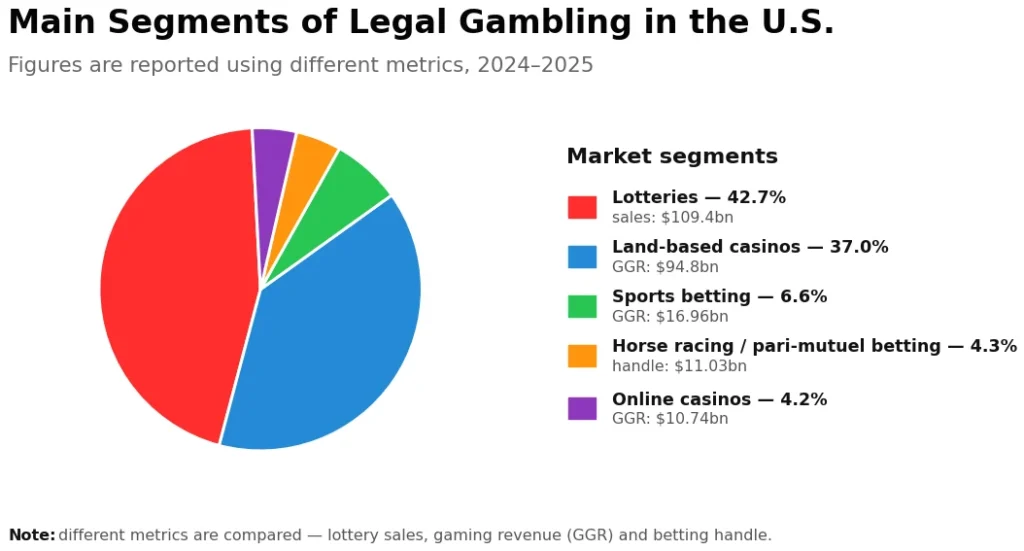
Lotteries in the United States are structured differently from casinos and sports betting. In most cases, they are run by the states themselves through government lottery commissions. Lotteries operate in 45 of the 50 states, as well as in the District of Columbia. There is no single federal lottery in the country.
At the same time, the U.S. has major multi-state lottery games, most notably Powerball and Mega Millions. Their tickets are sold across dozens of jurisdictions, allowing prize pools to grow quickly and jackpots to reach hundreds of millions, and sometimes even billions, of dollars.
PARADOX: Lotteries are the form of gambling with the highest house edge in the United States. The odds of winning the Powerball jackpot are about 1 in 292 million. On average, players lose 20 to 80 cents of every dollar they spend. But this does not stop consumers.
In the United States, lotteries are not limited to major jackpot draws and traditional draw-based games. Video lottery terminals, or VLTs, are a separate category. These terminals look similar to slot machines, but in some states they are regulated through the lottery system rather than as traditional casino games.
For this reason, VLTs are best understood as a borderline format between lotteries and slots.
Horse Racing
Horse racing betting is one of the oldest legal forms of gambling in the United States. It existed long before the sports betting boom that followed 2018 and is regulated separately.
Bets on horse racing can be placed in three main ways: at a racetrack, at an off-track betting venue or online.
However, its status as one of the oldest legal gambling segments has not protected the industry from decline.
FACT: Horse racing is the only major gambling segment in the United States that is not growing. Since the 2000s, horse racing handle* has almost halved, falling from more than $15 billion to around $11 billion today.
- The average racetrack visitor is over 50. Younger players tend to prefer sports betting and online casinos.
- Horse racing betting works through a shared pool: part of the money is returned to winning bettors, part goes to prize money and industry costs, and part goes to state budgets.
- Live racing generates little revenue on its own. Many tracks survive largely thanks to historical horse racing, or HHR** machines.
* Handle means total betting volume, not revenue.
** HHR machines allow players to bet on recordings of past real races, with the names of the horses and race details hidden.
Prediction Markets in the United States
Prediction markets are the most controversial new segment of U.S. gambling. They do not operate like traditional sportsbooks. Platforms such as Kalshi do not offer bets with fixed odds; instead, they offer event contracts — trades tied to the outcome of a specific event.
These platforms are not regulated under individual state sports betting laws. Instead, they fall under federal oversight through the CFTC, the U.S. Commodity Futures Trading Commission.
There are two major players and two different models.
- Kalshi is a legal U.S. prediction market platform regulated by the CFTC. It is not structured as a sportsbook, but as an exchange for event contracts: users buy and sell contracts based on the outcomes of events.
- Polymarket follows a different model. It is a crypto-based prediction market platform that long operated outside the U.S. regulatory system. After action by the CFTC, it restricted access for U.S. users. In 2025, Polymarket began preparing a legal return to the U.S. market by acquiring QCEX/QC Clearing, a CFTC-licensed exchange and clearing infrastructure.
The market is not limited to Kalshi and Polymarket. Other players include ForecastEx, Robinhood Event Contracts, Crypto.com Predict, PredictIt and others.
According to the Congressional Research Service, trading volume on Kalshi reached $39.7 billion in the 12 months to February 2026. Around 87% of that volume came from sports events. Polymarket’s trading volume over the same period was estimated at $36.2 billion, with sports accounting for about 38%.
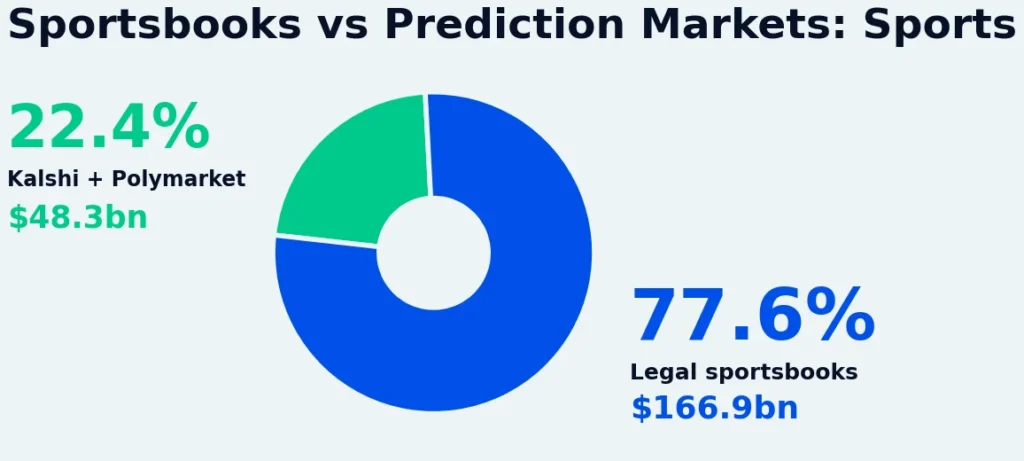
The central question for prediction markets is now being decided: are they financial contracts or sports bets?
For states, the dispute is not only legal, but also fiscal. These platforms do not obtain sportsbook licenses and do not pay state gaming taxes, even though they effectively compete with licensed sportsbooks. That is why sports event contracts are opposed by state regulators, sportsbook operators, tribal gaming groups, sports leagues and responsible gambling organizations.
Other Forms of Gambling in the United States
Beyond the major segments, the United States also has less unified and more local forms of gambling.
- These include charitable gaming, such as bingo, raffles and pull-tabs, which are run by nonprofit organizations, religious communities and veterans’ clubs.
- Cardrooms and poker clubs are another separate category, especially in California, where they operate under their own rules.
- Daily fantasy sports is also a disputed format: in some states it is regulated, while in others it remains closer to a gray area.
- Other borderline models include sweepstakes casinos, social casinos and skill machines. They may look like casinos or slot machines, but they are often structured differently from a legal standpoint, which regularly leads to disputes with regulators.
These formats are smaller in scale than casinos, lotteries and sports betting, but they are important for understanding the full picture of the U.S. gambling market.


Best Bonuses

Binance Referral ID — Inviter Code
Active Until: 22.12.2029
Along with up to $100 in welcome rewards, you receive a 5% fee rebate on Spot trading and a 5% fee rebate on Futures trading.

Win Win Promo Code – Valid Bonus Code Today
Active Until: 22.12.2028
Get 100% first-deposit bonus for sports betting, followed by extra bonuses on the 2nd, 3rd and 4th deposits after the welcome bonus has been wagered.

BitStarz Bonus Code – Welcome Bonus
Active Until: 22.12.2026
BitStarz offers a welcome bonus: up to $500 or 5 BTC, plus extra rewards after your first deposit.

Best Linebet Promo Code for New Users: 2 Welcome Bonuses
Active Until: 22.12.2026
Up to 1766 USD + 150 free spins for casino or a 100% sports bonus up to 117.89 USD on the first deposit.

Working 888starz.bet Promo Code – Sports & Casino Bonus
Active Until: 22.12.2027
Promo code unlocks the full welcome package, including up to €1500 + 150 Free Spins in the casino and up to €400 in sport.

Working Pinco Promo Code 2026 – Elite Welcome Rewards
Active Until: 22.12.2026
New players at Pinco can claim a 160% casino bonus on their first deposit by registering with the promo code GPARK.