Longer Exhales May Make People More Willing to Take Financial Risks

Xenia Luch
08 September 2026
Comment 0

Scientists have found that breathing with a prolonged exhalation may affect a person’s willingness to make risky decisions. The findings were published in the scientific journal Neuron.
The researchers compared two controlled breathing patterns: one with a long exhalation — a two-second inhale followed by an eight-second exhale — and another with a long inhalation — an eight-second inhale followed by a two-second exhale. The aim was to examine whether different breathing rhythms affect people’s willingness to take financial risks.
The experiment involved 41 participants. They were offered 50/50 monetary gambles, with an equal chance of winning or losing a specified amount. Potential gains ranged from €10 to €30, while potential losses ranged from €5 to €15. The difference was intentional, reflecting the well-established tendency for people to react more strongly to losing money than to gaining the same amount.
Each participant made decisions on 120 such gambles while breathing normally and another 120 while using the prolonged-exhalation breathing pattern.
Researchers found that participants were more likely to accept risky gambles when breathing with a prolonged exhalation. The prospect of a potential reward appeared to carry more weight in their decision-making.
Measurements also showed that prolonged exhalation increased cardiac parasympathetic activity*, with greater variation in the intervals between heartbeats. Participants who showed a stronger physiological response also displayed a stronger brain response to potential rewards.
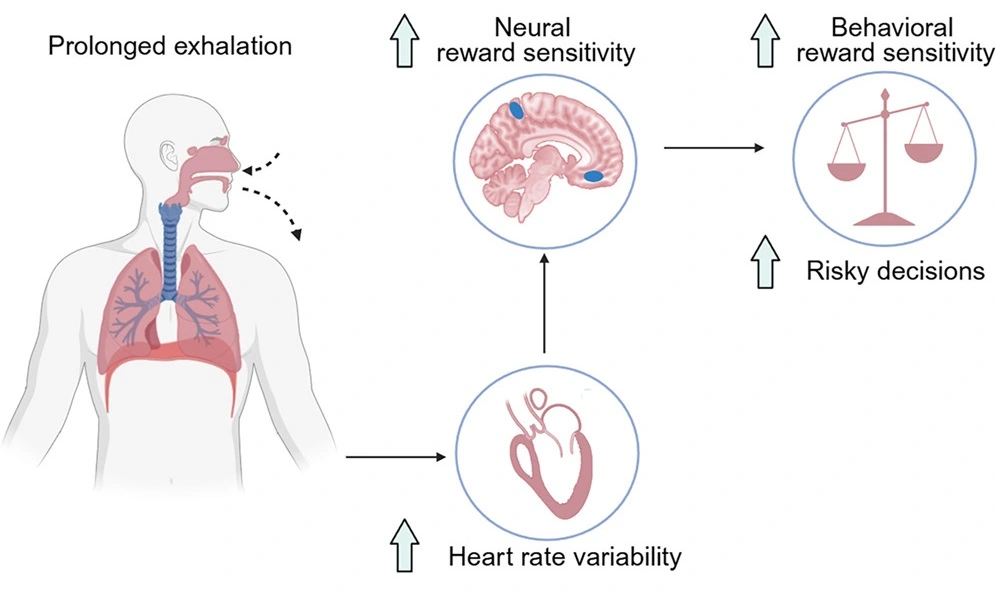
The findings may also be relevant to gambling and sports betting, where people regularly weigh the possibility of a financial gain against the risk of losing money. The study suggests that such decisions may be influenced not only by odds, stake size and the probability of an outcome, but also by a person’s breathing pattern.
However, the research was not conducted specifically among gamblers or bettors. It therefore cannot yet be concluded that the same effect occurs during real-money betting or casino gambling.
* Cardiac parasympathetic activity refers to the influence of the parasympathetic nervous system on heart rhythm and is generally associated with a state of rest. In this study, stronger parasympathetic activity was linked to a greater brain response to potential rewards and a higher willingness to take risks.

Best Bonuses

Binance Referral ID — Inviter Code
Active Until: 22.12.2029
Along with up to $100 in welcome rewards, you receive a 5% fee rebate on Spot trading and a 5% fee rebate on Futures trading.

Win Win Promo Code – Valid Bonus Code Today
Active Until: 22.12.2028
Get 100% first-deposit bonus for sports betting, followed by extra bonuses on the 2nd, 3rd and 4th deposits after the welcome bonus has been wagered.

BitStarz Bonus Code – Welcome Bonus
Active Until: 22.12.2026
BitStarz offers a welcome bonus: up to $500 or 5 BTC, plus extra rewards after your first deposit.

Best Linebet Promo Code for New Users: 2 Welcome Bonuses
Active Until: 22.12.2026
Up to 1766 USD + 150 free spins for casino or a 100% sports bonus up to 117.89 USD on the first deposit.

Working 888starz.bet Promo Code – Sports & Casino Bonus
Active Until: 22.12.2027
Promo code unlocks the full welcome package, including up to €1500 + 150 Free Spins in the casino and up to €400 in sport.

Working Pinco Promo Code 2026 – Elite Welcome Rewards
Active Until: 22.12.2026
New players at Pinco can claim a 160% casino bonus on their first deposit by registering with the promo code GPARK.